


SUMMARY
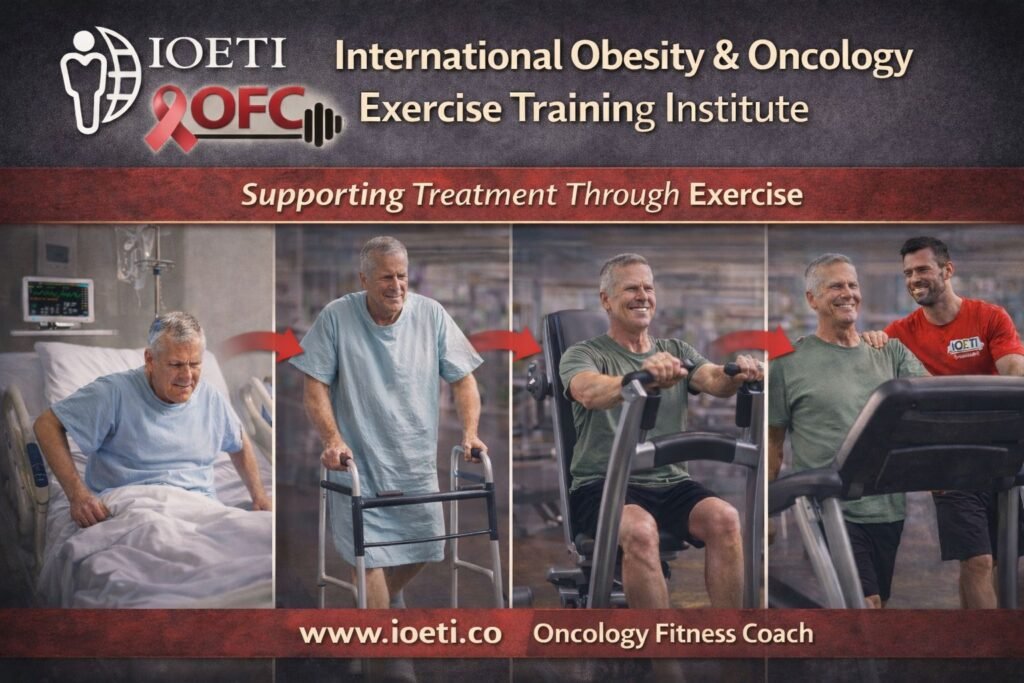
Cancer and its treatments can produce substantial short- and long-term effects on physical function, fitness, symptoms, and quality of life. Exercise can be introduced across the cancer trajectory, from prehabilitation and active treatment through pre-survivorship and survivorship. This pilot course provides a concise, practice-oriented introduction to exercise oncology, linking foundational cancer knowledge with exercise screening, fitness assessment, individualized prescription, supervised training, and tumor-specific program modifications.
PURPOSE
To translate the principles presented in Exercise Oncology Instructor: Principles & Practice into practical skills that enable exercise professionals to safely screen, assess, prescribe, monitor, and modify individualized exercise programs for medically cleared people affected by cancer.
Learning Objectives
- Understand the basic pathophysiology of cancer, cancer classification and staging, and the major treatment modalities and treatment-related adverse effects relevant to exercise.
- Describe the role of exercise across the cancer continuum and apply exercise guidelines for cancer populations.
- Conduct and interpret a foundational fitness assessment, including cardiorespiratory fitness, muscular strength and endurance, flexibility, body composition, balance, mobility, and coordination.
- Apply exercise training principles and the principles of overload, progression, specificity, rest, flexibility, and balance to individualized exercise prescription.
- Recognize readiness-to-exercise concerns, warning signs, and contraindications that require session modification, postponement, or referral.
- Modify exercise programming according to treatment status, day-to-day symptoms, functional limitations, and tumor-specific considerations.
- Next Intake:
30th April 2027 (Fri)
9am to 5pm - Course Fee:
Early Bird: S$400 (Ends 21st Feb 2027)
Regular: S$460 For more information, please refer to our FAQ here.
TAKE-AWAY POINTS
- A practical framework for progressing from medical history and clearance to assessment, exercise prescription, supervised training, reassessment, and program modification.
- Applied methods for monitoring exercise intensity and tolerance and adapting training to treatment-related fatigue and changing health status.
- Practical programming strategies for aerobic, resistance, flexibility, balance, and functional exercise in cancer populations.
- Tumor-specific programming considerations and case-based problem solving for common cancer populations.
ASSESSMENT
- Completion of the guided pre-course reading.
- Participation in practical assessment/programming activities and case-study discussion.
- Short recap quiz at the end of the contact course.
COURSE MATERIALS
- Digital textbook.
- Case-study and exercise-programming worksheets used during the contact course.
- Certificate of attendance/completion.
COURSE OUTLINE (8 HOURS)
Module 1 – Foundations of Exercise Oncology (2 hours)
- Role and scope of the Exercise Oncology Instructor
- The cancer continuum: prehabilitation, active treatment, pre-survivorship, and survivorship
- Cancer pathophysiology, diagnosis, staging, and common tumor classifications
- Surgery, chemotherapy, radiation, hormonal therapy, and biologic/immunotherapy
- Common treatment-related adverse effects relevant to exercise
- Benefits of exercise and physical activity recommendations for cancer populations
Module 2 – Screening, Safety, and Fitness Assessment (2 hours)
- Medical and cancer history, physician clearance, and readiness to exercise
- Resting heart rate, blood pressure, symptoms, and pre-session monitoring
- Warning signs, contraindications, and criteria for modifying or stopping exercise
- Assessment of body composition, cardiorespiratory fitness, muscular strength, muscular endurance, flexibility, balance, mobility, and coordination
- Using assessment findings to identify strengths, limitations, goals, and programming priorities
- Demonstration and interpretation of selected assessment procedures
Module 3 – Exercise Prescription and Supervised Training (2 hours)
- Applying exercise training principles to cancer exercise prescription
- Overload, progression, specificity, rest, flexibility, and balance
- Designing whole-body aerobic and resistance training programs
- Warm-up, aerobic training, resistance training, flexibility, and session monitoring
- Using heart rate, blood pressure, RPE, symptoms, and short recovery breaks to regulate training
- Adapting exercise to fatigue, medications, treatment cycles, functional status, and day-to-day changes
- Practical programming activity
Module 4 – Tumor-Specific Programming and Case Studies (2 hours)
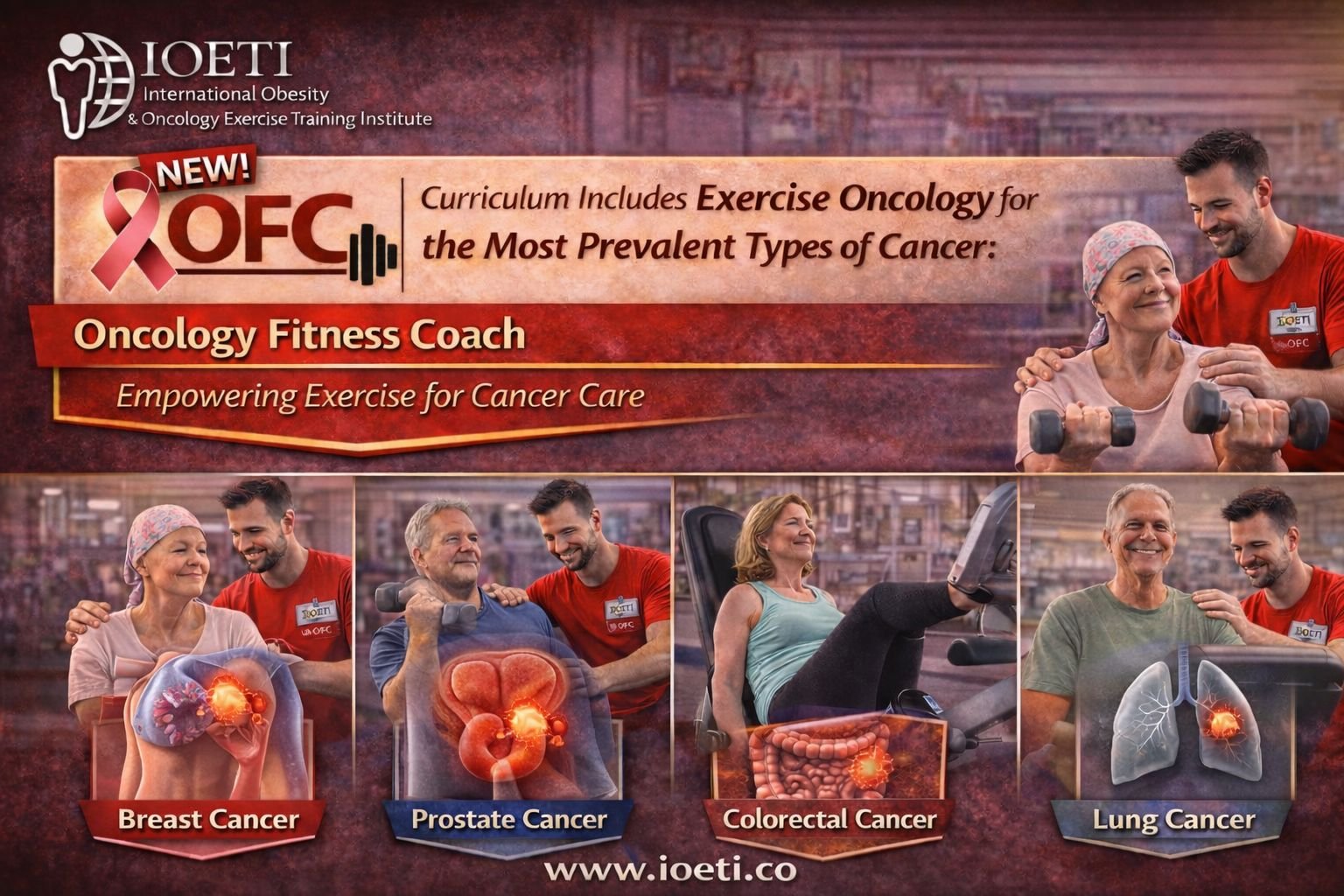
- Lung cancer: dyspnea, deconditioning, oxygen saturation, and progressive aerobic/functional training
- Breast cancer: lymphedema, upper-body function, and progressive resistance exercise
- Prostate cancer: androgen-deprivation therapy, bone health, fall risk, muscle loss, and pelvic-floor considerations
- Colorectal cancer: ostomy/parastomal hernia, hydration, chemotherapy pumps, abdominal pressure, and post-surgical considerations
- Small-group case studies: interpreting assessment findings and designing individualized programs
- Recap quiz, discussion, and pilot-course feedback
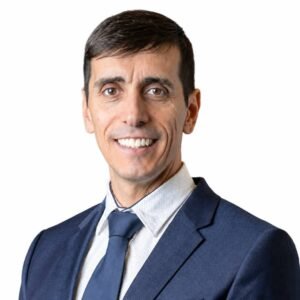
Dr. Alexis Batrakoulis, PhD, CSCS, CSPS, NSCA-CPT, ACSM-EP, ACSM-CPT, FACSM
Dr. Batrakoulis has been involved in the health and fitness industry for the past 30 years working as a personal trainer, exercise physiologist, fitness educator, subject matter expert, and speaker presenting in 45 countries across five continents. He currently works as an Assistant Professor of Applied and Clinical Exercise Physiology at European University Cyprus, and is based in Nicosia, Cyprus. He holds a B.S. in Physical Education and Sports Science with an emphasis on fitness, an M.S. in Exercise and Health, and a Ph.D. in Clinical Exercise Physiology, with both graduate degrees focusing on exercise and obesity. His primary research interests focus on the role of hybrid multicomponent exercise training in obesity. He has authored over 150 international peer-reviewed publications on exercise, including research articles and textbook chapters with over 4000 citations. Recently, he was selected to author a chapter in the latest edition of the ACSM’s and NSCA’s Personal Training textbooks. In 2025 and 2026, he was recognized as one of the top 2% (0.5% to be exact) of Sport Scientists worldwide, based on his research contributions. He has also earned numerous professional credentials through ACSM (EP, CPT, and EIM), NSCA (CSCS, CSPS, and NSCA-CPT), ACE (CMES, CHC, CPT, WMS, YFS, SFS, TES, and FNS), and NASM (CES, PES, and WLS). As the founder of the International Obesity & Oncology Exercise Training Institute (IOETI) teaches in-person and online continuing education courses approved by ACE, ACSM, AFAA, NASM, and NSCA for health and fitness professionals around the globe. Additionally, he has been an ACE subject matter expert and international master trainer as well as a deputy director of the Professional Standards Committee at EuropeActive, which leads the development of educational standards, oversees the accreditation process for all courses, and registers qualified exercise professionals for all occupational roles in the European fitness sector. More specifically, he has respectively led and contributed to the Technical Experts Groups that developed standards for the occupational roles of Weight Management Exercise Specialist and Pre/Diabetes Exercise Specialist in Europe. Additionally, he has been serving on several ACSM and NSCA Committees, has been the Chair of the ACSM’s Committee for Certification and Registry Boards International Subcommittee, and has also been involved in the NSCA Education Recognition Program as the CSCS and NSCA-CPT Sponsor for the Undergraduate and Personal Training programs at the University of Thessaly in Greece. He is an ACSM Fellow and serves on the NSCA Board of Directors as the Personal Trainer Representative. He is also a Lead External Consultant for the International Confederation of Registers of Exercise Professionals’ (ICREPs) Global Standards Advisory Committee. He received global recognition as the 2017 IDEA Personal Trainer of the Year Finalist, 2018 IDEA Personal Trainer of the Year, 2019 IDEA China Fitness Innovator, 2020 NSCA Personal Trainer of the Year, 2020 MedFit Professional of the Year Finalist, 2021 PFP Trainer of the Year, 2021 ACSM Certified Professional of the Year Finalist, and 2022 ACSM Certified Professional of the Year.
